
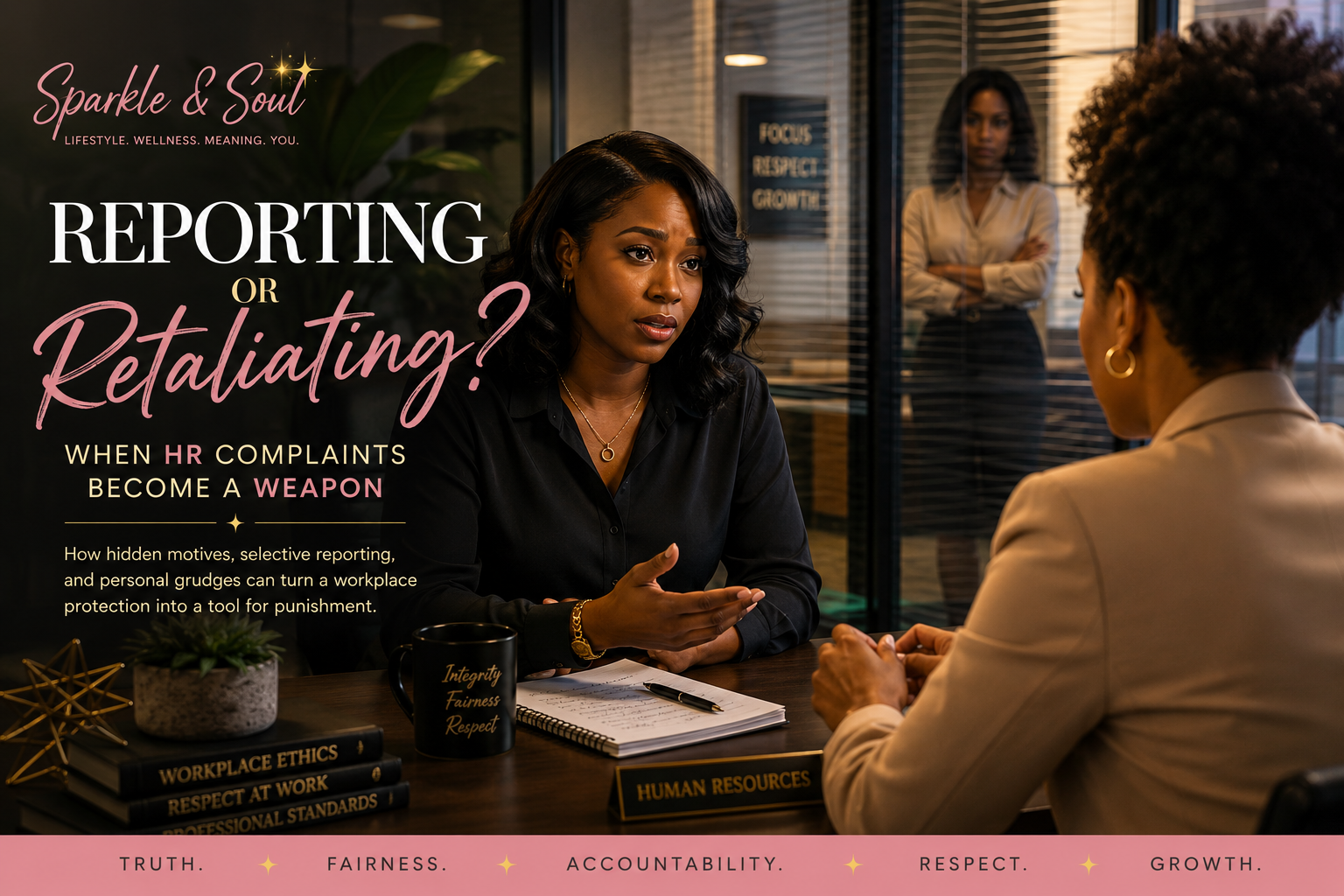
How hidden motives, selective reporting, and personal grudges can turn a workplace protection into a tool for punishment.

Digital art by SoulSparkles Visual Studio
Written by Stef Sparkles · July 22, 2026 · 9 min read
Human Resources should be used to address genuine workplace concerns, not to carry out personal vendettas. Before making a report, employees should examine whether they are seeking fairness and accountability or simply searching for an official way to hurt someone they already dislike.
Workplace reporting systems serve an important purpose. Employees need a safe way to raise concerns involving harassment, discrimination, threats, safety violations, fraud, retaliation, and other serious misconduct. Federal employment laws protect many workers who report discrimination or participate in related complaint processes, while federal safety laws also protect certain workers who raise workplace health and safety concerns.[1][2]
But the ability to report a concern can also be misused.
Sometimes a complaint is not motivated by safety, fairness, or accountability. Sometimes it begins with resentment. A coworker received an opportunity someone else wanted. A friendship ended badly. Someone enforced a boundary, challenged a decision, rejected unwanted attention, or refused to participate in workplace politics.
Instead of addressing the conflict honestly, the offended person begins collecting incidents.
Ordinary mistakes become evidence. Neutral conversations are interpreted in the worst possible way. Important context disappears. Other coworkers are encouraged to share negative stories, and HR becomes the official instrument through which a personal grudge is carried out.
At that point, the person may no longer be reporting misconduct in good faith.
They may be using the reporting process to manufacture consequences.
When a Complaint Has a Hidden Purpose
The phrase “weaponizing HR” is not a formal legal term. It describes the intentional use of workplace reporting procedures to intimidate, punish, discredit, or remove another employee for reasons that are not honestly disclosed.
The report may contain a small amount of truth. The person may have broken a minor rule, spoken sharply, made an ordinary mistake, or behaved imperfectly. But instead of reporting the situation fairly, the complainant stretches the facts, removes context, or presents the incident as part of a more serious pattern.
The real goal is not to solve a workplace problem. The goal is to place the targeted employee under suspicion.
Research on workplace social undermining describes conduct intended to damage another person’s work relationships, success, or reputation. Studies have connected undermining behavior with workplace rivalry, interpersonal conflict, envy, and other negative workplace experiences.[3]
HR weaponization can become one form of that undermining when someone uses an official complaint process to accomplish what gossip alone cannot.
Ask Yourself the Uncomfortable Question
Before contacting HR, ask yourself:
Am I reporting conduct that genuinely requires attention, or am I searching for an official way to hurt someone I already dislike?
That question may feel uncomfortable, but discomfort is not always a sign that the question is unfair. Sometimes it is a sign that it has reached the truth.
Consider what happened immediately before the desire to report arose.
Did the person receive a promotion, recognition, schedule, assignment, or opportunity you wanted?
Did they disagree with you publicly?
Did they stop socializing with you?
Did they reject a friendship, romantic interest, invitation, or personal request?
Did they report you first?
Did they establish a boundary that limited your access to them?
Did someone else encourage you to begin watching and documenting them?
A genuine workplace concern does not become invalid simply because personal conflict also exists. However, personal conflict should make you slow down and examine whether your description of the incident is accurate, proportionate, and complete.
Selective Reporting Is Not the Same as Fairness
One sign of weaponized reporting is selective outrage.
A behavior is ignored when friends or favored coworkers do it but suddenly becomes unacceptable when the disliked employee does the same thing.
One person arrives late and receives understanding. Another arrives late and becomes the subject of a formal complaint.
One employee raises their voice and is described as passionate. Another raises their voice and is described as aggressive, unstable, or threatening.
One person makes an honest mistake and receives coaching. Another makes the same mistake and is portrayed as reckless or intentionally disobedient.
Reporting only one person for behavior that is widely tolerated does not automatically prove malicious intent. Different incidents can have different consequences and circumstances. But when the same employee is repeatedly singled out while similar conduct from others is overlooked, the pattern deserves honest examination.
Fairness requires consistency. It means judging comparable conduct by comparable standards, even when your feelings toward the people involved are different.
Context Is Not an Optional Detail
Another common form of weaponization is reporting the technically accurate portion of an event while deliberately removing the information that would make it understandable.
Imagine telling HR:
“She refused to complete the assignment.”
That statement creates one impression.
The full context may be:
“She explained that she was already handling an emergency, asked which task should take priority, and said she could complete the assignment afterward.”
The first statement may not be completely false, but it is misleading because the missing information changes its meaning.
Context includes:
- What happened immediately before the incident
- What instructions were given
- Whether expectations were clear
- Whether the employee had competing responsibilities
- Whether the person attempted to explain or resolve the issue
- Whether the same behavior had previously been allowed
- Whether the reporter participated in escalating the conflict
Leaving out relevant information because it weakens your preferred conclusion is not responsible reporting. It is narrative management.
Be Careful With Emotional Language
Words matter, particularly when the people receiving the report were not present.
There is a meaningful difference between:
- “She disagreed with me” and “She became hostile.”
- “He spoke loudly” and “He threatened me.”
- “She looked frustrated” and “She was out of control.”
- “He asked why the procedure changed” and “He refused to cooperate.”
- “She stopped speaking to me socially” and “She created a hostile environment.”
Employees should never minimize conduct that is genuinely threatening, harassing, discriminatory, or unsafe. However, serious language should describe serious behavior.
Emotional labels can transform an ordinary conflict into something that sounds dangerous. Once words such as aggressive, threatening, unstable, harassing, or hostile enter a workplace record, they may affect how managers interpret every future interaction with that employee.
Describe what the person actually said or did. Let the investigator determine what category the behavior belongs in.
Do Not Recruit a Workplace Jury
People who want a coworker disciplined sometimes begin searching for confirmation.
They ask leading questions:
“Have you noticed how rude she is?”
“Has he ever done anything strange around you?”
“You have had problems with her too, haven’t you?”
Soon, separate complaints become one shared narrative. Employees repeat incidents they did not witness, interpret ordinary behavior through the group’s established opinion, and begin treating suspicion as proof.
This does not mean multiple people can never experience legitimate problems with the same person. Patterns matter, and witnesses should be allowed to speak honestly.
The problem begins when coworkers are coached, pressured, or encouraged to reinterpret events so that their stories support a desired outcome.
If you believe misconduct occurred, report your own experience. Do not campaign.
An Unproven Complaint Is Not Automatically a False Complaint
This distinction is essential.
A complaint may be made honestly and still remain unsubstantiated. Witnesses may remember events differently. Evidence may be incomplete. An employee may reasonably believe that conduct was discriminatory, harassing, unsafe, or improper even when an investigation does not reach the same conclusion.
EEOC guidance explains that certain opposition to discrimination may remain protected when an employee had a reasonable, good-faith belief that a violation might have occurred, even if the conduct is ultimately found lawful. Participation in formal EEO processes receives especially broad protection.[1]
Therefore, the mere fact that HR did not substantiate a complaint does not prove that the reporter lied.
Weaponization involves something more deliberate: knowingly distorting facts, concealing important context, applying standards selectively, encouraging others to build a case, or using the complaint process to achieve a personal punishment.
The difference is good-faith concern versus strategic harm.
Disliking Someone Does Not Make Their Conduct Acceptable
The opposite warning also matters.
Do not use the idea of “HR weaponization” to dismiss every report made by someone who has a complicated relationship with the accused person.
A person can dislike a coworker and still report something true.
A friendship can end badly, and misconduct can still occur afterward.
Someone can feel angry, jealous, or hurt and still witness a genuine violation.
The presence of mixed motives does not automatically erase evidence. The facts still require review.
That is why a fair workplace process should not rely solely on whether HR likes the complainant or the accused. It should examine documentation, witness accounts, surrounding circumstances, consistency, and available evidence.
Research on organizational justice has repeatedly linked fair procedures with employee trust in management and the organization.[4] A process loses credibility when accusations are automatically believed, automatically dismissed, or judged according to workplace popularity rather than evidence.
Consider the Damage You Are Trying to Cause
A workplace complaint can have consequences beyond an uncomfortable HR meeting.
The targeted employee may lose assignments, income, opportunities, relationships, professional credibility, or employment. They may begin working under increased scrutiny while trying to disprove a story that has already shaped management’s view of them.
Even when an allegation is ultimately dismissed, suspicion can linger.
Ask yourself honestly:
- Am I seeking correction or destruction?
- Would a direct conversation or routine management coaching solve the issue?
- Am I hoping this person loses their job?
- Am I leaving out information because I know it would make the situation appear less serious?
- Would I report the same conduct if a friend had done it?
- Am I reporting what happened, or what I believe this person deserves?
If your satisfaction depends more on the person suffering than on the workplace problem being resolved, your purpose may no longer be accountability.
It may be revenge wearing professional clothing.
What Ethical Reporting Looks Like
Ethical reporting does not require you to be emotionless. It requires you to be honest.
A responsible report:
- Separates witnessed facts from assumptions
- Includes relevant context
- Uses accurate, proportionate language
- Identifies secondhand information as secondhand
- Avoids diagnosing someone’s personality or mental state
- Does not recruit coworkers to strengthen the allegation
- Acknowledges the reporter’s own involvement in the conflict
- Focuses on resolving the workplace concern rather than demanding a specific punishment
A fair statement might read:
“During our conversation, she raised her voice and said, ‘I am not discussing this further.’ I felt uncomfortable with the interaction. Before that statement, we had disagreed about how the assignment should be completed. I am reporting what occurred and would like guidance on how future communication should be handled.”
That report communicates concern without turning personal interpretation into established fact.
HR Is Not a Personal Enforcement Department
Human Resources is not there to force coworkers to like you, socialize with you, agree with you, or give you the relationship you wanted.
A coworker setting a boundary is not automatically bullying.
A colleague disagreeing with you is not automatically insubordination.
Someone declining personal conversation is not automatically creating a hostile workplace.
Being uncomfortable does not always mean you have been mistreated.
Sometimes a workplace problem requires HR. Sometimes it requires management coaching, mediation, clarification of expectations, or a direct professional conversation. And sometimes it requires accepting that another adult does not owe you closeness, agreement, or access.
The complaint process should not become a shortcut around that reality.
Protect the Right to Report by Using It Responsibly
Bad-faith complaints do not only harm the person being targeted. They can also weaken trust in the entire reporting system.
When employees believe complaint procedures are driven by favoritism, politics, exaggeration, or personal grudges, they may become less confident that genuine concerns will receive a fair response. Research suggests that perceptions of procedural fairness are closely connected to organizational trust, which is one reason consistent and impartial review matters.[4]
People should feel safe reporting legitimate misconduct without retaliation. EEOC and OSHA protections exist because fear of punishment can silence workers who need to speak.[1][2]
That protection deserves respect.
Using HR as a weapon does not make a personal vendetta professional. It simply moves the vendetta into a conference room and gives it paperwork.
Before you report, tell the whole truth. Examine your motives. Use accurate language. Include context. Allow the facts to lead instead of forcing them toward the outcome you want.
A reporting system should protect employees from misconduct.
It should never become another form of it.
Footnotes
[1] U.S. Equal Employment Opportunity Commission. Enforcement Guidance on Retaliation and Related Issues. The guidance explains protected participation and opposition, including the role of reasonable good-faith belief, and notes that false or bad-faith statements may be considered by investigators when assessing credibility and the merits of an allegation.
[2] Occupational Safety and Health Administration. Worker Rights and Protections. OSHA explains that workers may be protected from employer retaliation for raising certain workplace health and safety concerns or exercising rights covered by whistleblower laws.
[3] Song, Y., et al. “Social Undermining and Interpersonal Rumination Among Employees: The Mediating Role of Being the Subject of Envy and the Moderating Role of Social Support.” The study discusses coworker and supervisor undermining, including links with rivalry, interpersonal conflict, envy, rumination, and employee well-being. It builds on earlier workplace-undermining research by Duffy, Ganster, and Pagon.
[4] Pan, X., et al. “The Effects of Organizational Justice on Positive Organizational Behavior.” Frontiers in Psychology. Research on organizational justice associates fair decision-making procedures with employee trust, commitment, and other workplace outcomes.
This article offers general workplace guidance and is not legal advice. Employees facing discrimination, harassment, retaliation, safety hazards, or other serious misconduct should use the appropriate internal or external reporting channels available to them.
Leave a Reply